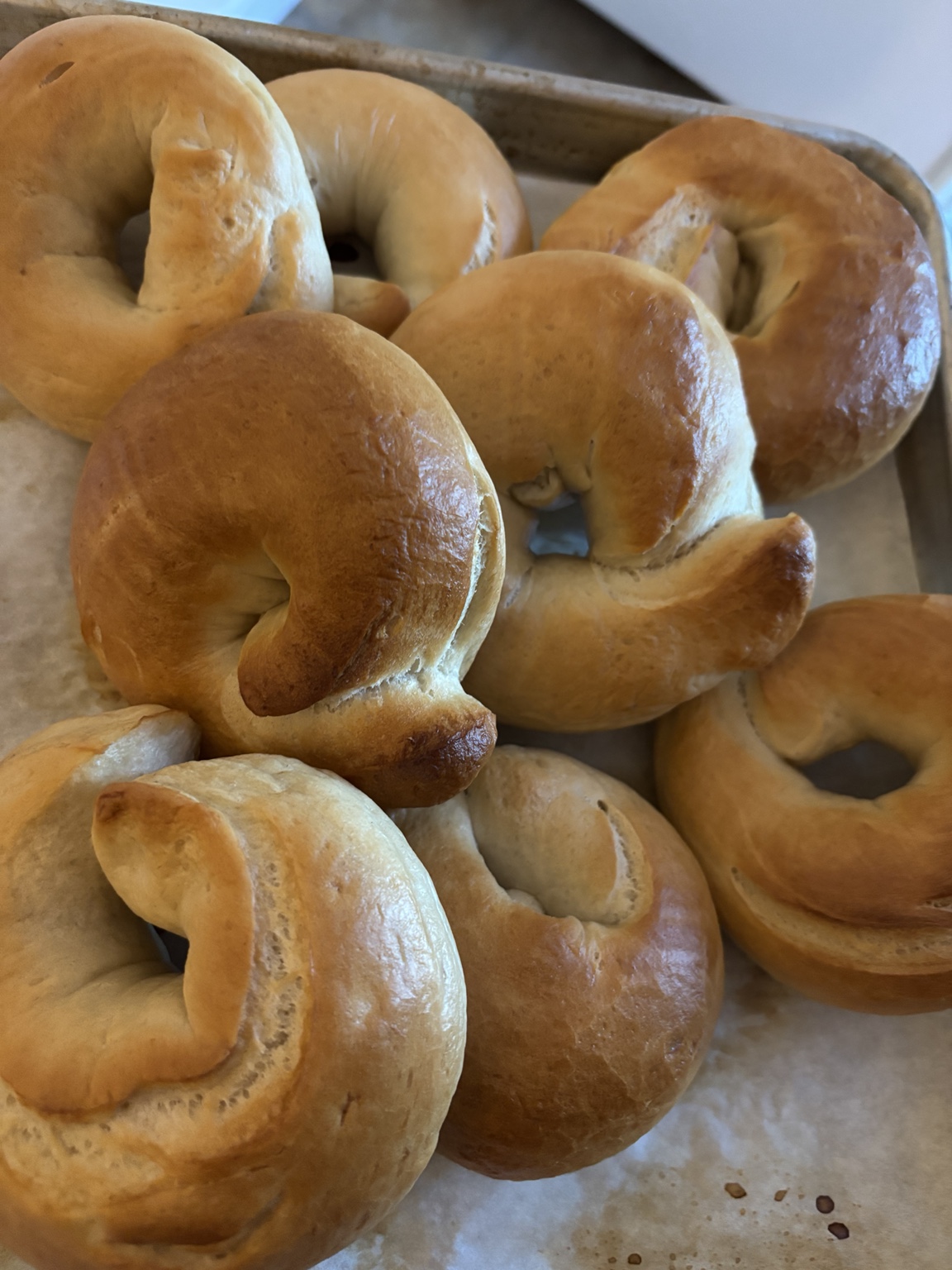
Fresh-milled sourdough bagels are a good excuse to use up the discard in your fridge and make breakfast at the same time. This recipe uses freshly milled hard wheat and a little active dry yeast, so you don’t have to wait for your starter to be ready.
They’re hearty, chewy, and ready for whatever toppings you have in the pantry. Make a batch for breakfast, slice a few for sandwiches, and freeze the rest for another day.
Making fresh-milled sourdough bagels
The biggest difference when working with fresh-milled flour is giving it time to absorb the water. A short rest before kneading helps soften the bran and makes the dough easier to work with.
Use hard white or hard red wheat for this recipe. Hard white has a milder flavor, while hard red makes a more pronounced whole-wheat bagel. Soft wheat won’t provide the same dough strength.
The dough should feel firm and slightly tacky. It won’t feel as soft as sandwich bread dough, and it doesn’t need to. Add extra water a little at a time only if the dough stays dry or cracks as you knead.
Why use yeast with sourdough discard in fresh-milled sourdough bagels?
Discard adds flavor, but its rising power can vary. Active dry yeast provides the lift in this recipe, so the discard doesn’t have to be freshly fed or bubbly. These are yeast-assisted discard bagels, with a shorter rise than bagels made using only an active starter.
Don’t skip the boil
A quick boil before baking helps set the outside of the bagels and gives them their chewy crust. Add your toppings as soon as they come out of the water so the seeds or seasoning can stick.
Make breakfast easier
Once the bagels are completely cool, slice them before freezing. That way you can pull one out and put it straight in the toaster without having to thaw and cut it first.
If you’re looking for another way to use your freshly milled flour, try my brown butter chocolate chip cookies. Breakfast now… cookies later.
Fresh-Milled Sourdough Bagels
Ingredients
Method
- Hydrate the flour. Combine the freshly milled flour, sourdough discard, and 260 g of the water until no dry flour remains. Cover and rest for 30 minutes.
- Activate the yeast. During the last 10 minutes of the flour rest, combine the remaining 50 g water, warmed to 105–110°F, with the active dry yeast and 25 g honey or brown sugar. Let stand for 5–10 minutes, until foamy.
- Knead. Add the yeast mixture and salt to the rested dough. Squeeze and fold until incorporated, then knead for about 8–10 minutes, or until firm, cohesive, and elastic. Whole-grain dough may retain a slightly textured surface. If it remains dry or cracks when worked, add water 5 g at a time. If using a mixer, follow its speed and dough-capacity guidance for stiff dough.
- Let rise. Cover and let rise for 60–90 minutes, or until noticeably puffy and expanded. It may take longer in a cool kitchen. Whole-grain dough may not fully double.
- Divide and shape. Divide into 8 equal pieces, approximately 122 g each. Roll into tight balls, cover, and rest for 10 minutes. Poke a hole through each center and gently stretch it to about 2 inches wide; the holes will shrink as the dough rests and bakes.
- Proof and preheat. Place on a parchment-lined baking sheet, cover, and rest for 20–30 minutes, until slightly puffy. Meanwhile, heat the oven to 425°F.
- Boil. Bring the 2,000 g water and 40 g honey or brown sugar to a gentle boil in a pot wide enough for the bagels. Boil in batches for 30 seconds per side. Keep the bagels in a single layer without crowding. Remove with a slotted spoon and drain briefly.
- Top and bake. Return to the lined baking sheet and add toppings while the surfaces are still damp. Bake for 22–27 minutes, until deeply golden and baked through.
- Cool. Transfer to a rack and cool for at least 30 minutes before slicing.
Notes
Plain with butter, loaded with cream cheese, or turned into a breakfast sandwich… there’s really no wrong answer here. Let me know your favorite bagel topping in the comments! If you make these fresh-milled sourdough discard bagels, I’d love for you to leave a rating below.
Thinking about milling your own flour? I use my NutriMill for recipes like these bagels, homemade bread, and cookies. You can shop through my affiliate link and use code HAH20 at checkout. I may earn a commission when you purchase through my link, at no extra cost to you.
Leave a Reply